 Transcripts
A worked example: Adventure Log
Everything in this guide so far has been about getting a recording filed correctly. This page is about what happens next — what it looks like when something else picks the transcripts up and does its own work with them.
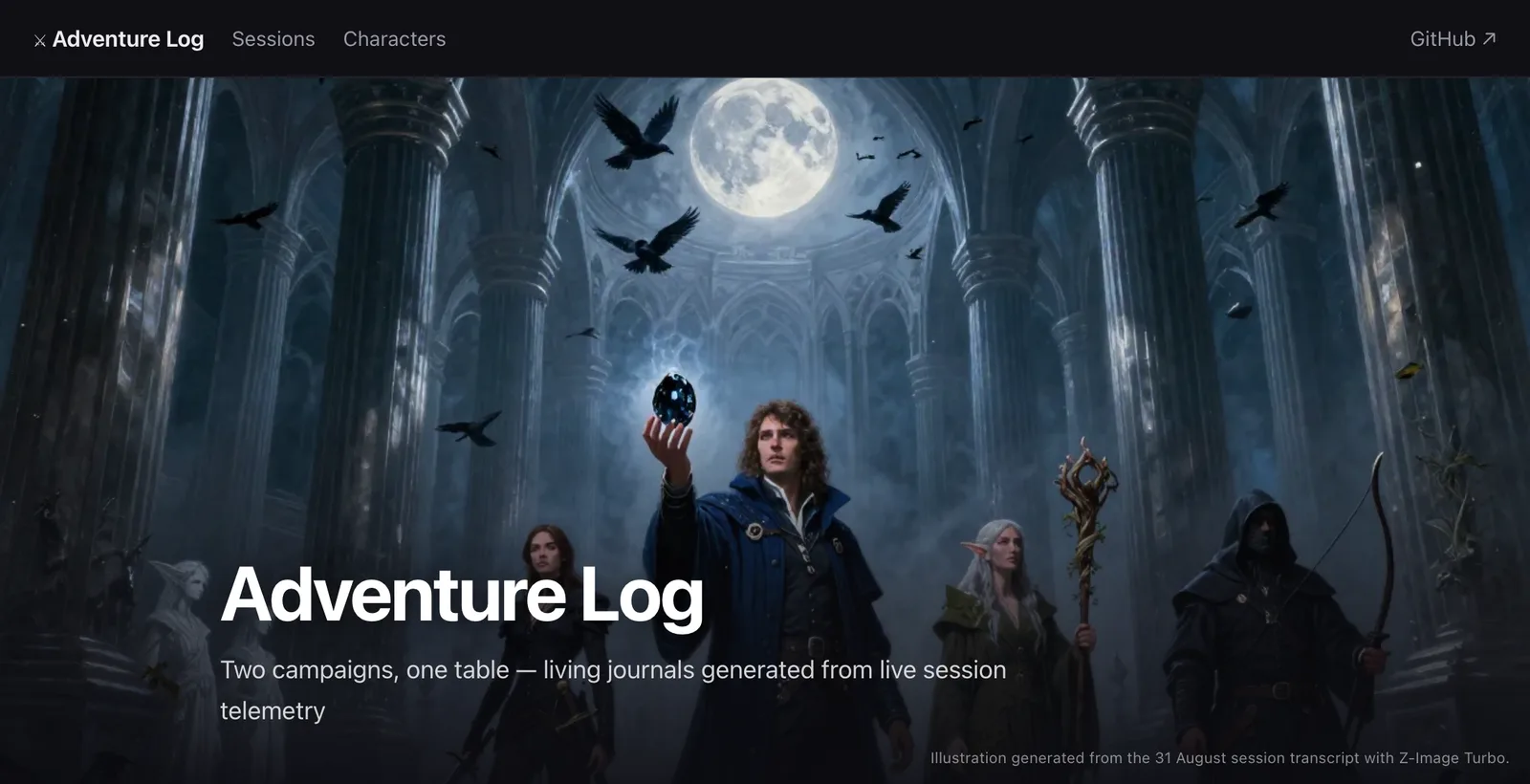
Adventure Log is a live companion for a Dungeons & Dragons table. It publishes a campaign journal to doughatcher.github.io/adventure-log, tracks hit points and combat state during play, and writes a session brief for the next game. It is not part of Transcripts and is not built by the same machinery. It is a separate program that happens to read what Transcripts writes, which is the point of the example: the documents in your folder are a format other things can consume.
During the game
The journal is what the table gets afterwards. There's a use during the game too, because the live transcript is a plain file that grows turn by turn while the recording runs.
On 31 August the party arrived at the Shadow Fey's lower court, where standing is scored by the DM, point by point, for skill checks made in front of the right people. Mid-session, with the recorder still going, Aldric's player asked Claude to read live.md and suggest a way in. The answer came from what had actually been said at the table in the previous hour. It had the running status tally, which rooms and people the DM had described, and the fact that another player had just announced he was working the room with Persuasion. From that it suggested five openings that suited a diviner rather than a courtier: proofread the bearfolk emissary's letter before it was sealed, read an omen for the squire before his duel, and so on. It also pointed out a thread nobody had pulled: the whole party was wearing the Winter King's insignia, and no one had asked what that signalled at court.
None of this needed an integration. The assistant read a Markdown file the recorder was already writing.
What the evening looks like
A session at the table is not one recording. Someone starts the recorder before people have settled, it stops when the pizza arrives, it starts again. By the end of the night the folder holds several documents that are all the same evening.
Transcripts already knows they belong together — that is what a session is, and Sorting and sessions covers how it decides. What matters here is the last step: when the session is genuinely over, onComplete runs once and hands over every document in it at the same time.
That "once, with all of them" is the part worth noticing. A hook that fired per recording would see four fragments of an evening and have no way to know it was holding fragments. Adventure Log's importer receives the whole night in one go and folds it into a single transcript, which is the only reason a journal entry can read as one continuous session.
What it does with them
The importer stitches the documents into one file, then a generator turns that into a written journal entry, character updates, and a brief for next time. Local models do the writing, so the campaign — which contains a great deal of ordinary conversation between friends — never leaves the machine.
Two of its decisions are worth repeating here, because they are the kind of thing anyone building on a recorder eventually runs into.
It throws away everything before the game started. A recorder that has been running all afternoon has an afternoon in it. The importer knows when the session began, works out a real wall-clock time for every line by combining each document's recorded_at with its turn timestamps, and drops anything earlier. The campaign journal is a public website; the work call before the game is not part of the campaign.
When it cannot place a line on that timeline, it refuses. An older document written before turns were stamped cannot be trimmed reliably, and the importer stops rather than guessing. Publishing an untrimmed transcript to a public site is not a mistake you can take back, so the failure is deliberately noisy and deliberately early.
It also opens a pull request instead of pushing. A person reads the session before it goes up.
One table, two campaigns
The table plays two campaigns in turn, depending on which DM is free. The importer won't guess which one a night belongs to: filed under the wrong party, a session is a mess to undo on a public site. So --campaign is required, and each campaign gets its own session profile, with the campaign in the profile's id:
"sessions": [
  {
    "id": "courts-of-the-shadow-fey",
    "name": "D&D — Courts of the Shadow Fey",
    "destination": "Campaigns/transcripts/",
    "hardStop": "23:30",
    "onComplete": {
      "executable": "/usr/bin/python3",
      "arguments": ["scripts/import_transcripts_session.py",
                    "--campaign", "${sessionID}", "--slug", "${slug}",
                    "--started-at", "${startedAt}", "--ended-at", "${endedAt}",
                    "--transcripts", "${transcripts}"],
      "workingDirectory": "/Users/me/repos/adventure-log"
    }
  },
  { "id": "shard-sea", "name": "D&D — Shard Sea", "...": "the same" }
]
Starting a session is then the same act as saying which game it is.
When the session isn't started
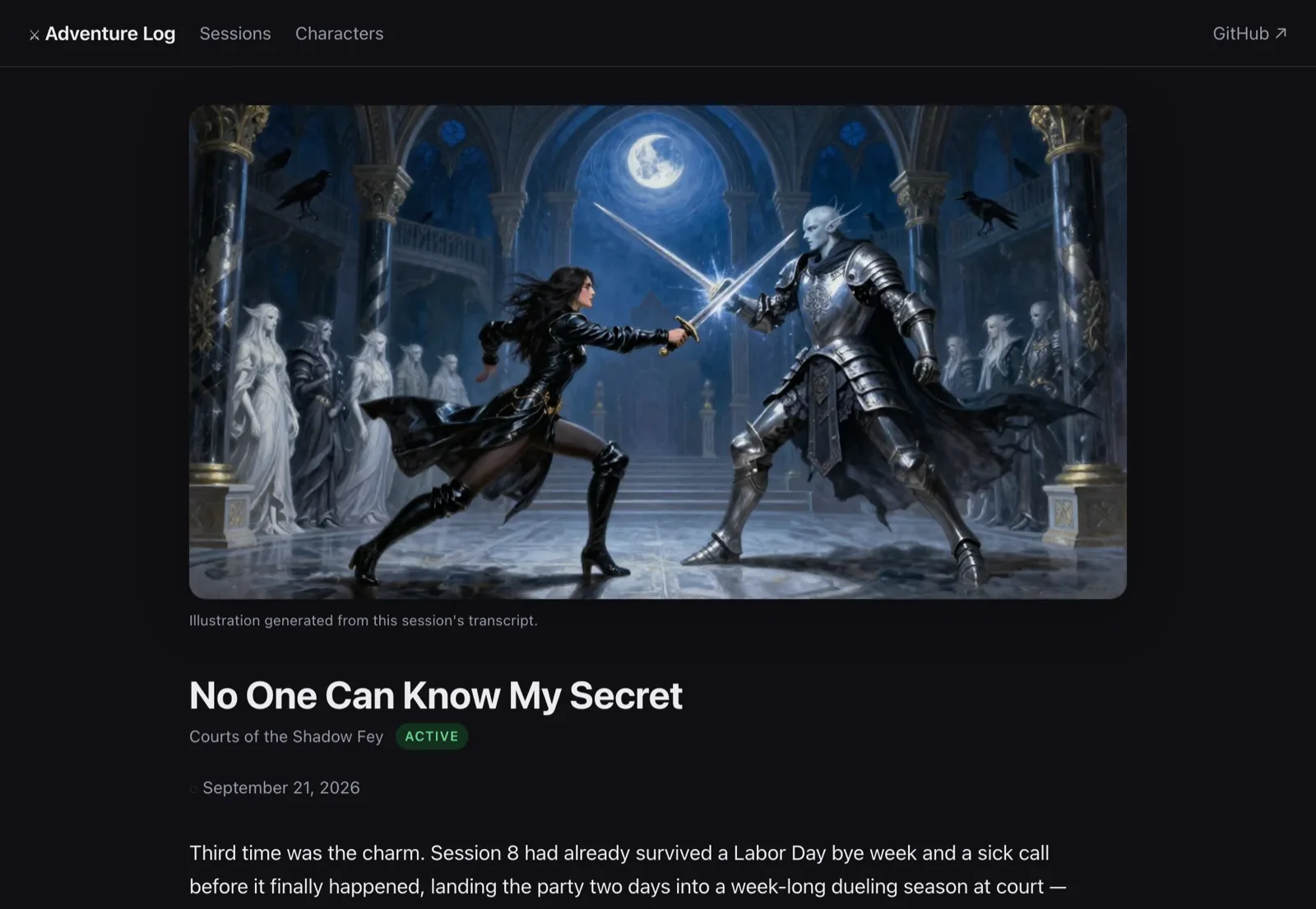
It happens. On 21 September the recorder ran for the whole evening, two hours and twenty minutes of play, but nobody started the session. Transcripts did what it does with any recording: it transcribed it, summarised it and sorted it into the general transcripts/ folder. No session ended, so onComplete never ran and nothing reached the journal.
Nothing was lost, because the transcript is an ordinary file with its recorded_at and timestamped turns. The importer takes any documents, not just a session's, so the night went up by hand the next morning:
python3 scripts/import_transcripts_session.py \
  --campaign courts-of-the-shadow-fey --slug 2026-09-21-courts-of-the-shadow-fey \
  --started-at 2026-09-21T22:37:31Z --ended-at 2026-09-22T00:59:10Z \
  --transcripts ".../transcripts/2026-09-21-1837-duel-court-update-summary.md"
It kept all 895 turns, dropped none from outside the evening, and opened a pull request to read before publishing.
Why this is the shape to copy
Nothing above required Transcripts to know anything about D&D. The app files Markdown into a folder with a stable front matter block and timestamped turns; onComplete says when a session is finished and what it contained. Everything specific to the campaign lives in the other program.
If you are building something similar, the mechanics of the hook — what it receives, when it fires, and how to test it without waiting for a real session — are in Sorting and sessions, and the full configuration is in the routing.json reference.
Next: Privacy